Enabling Intervention Infrastructure for BEAD Oversight
The $42B Broadband Equity, Access, and Deployment (BEAD) program is the largest broadband infrastructure investment in U.S. history. But past experience shows that infrastructure spending alone does not guarantee affordable, adoptable service. Prior programs, especially CAF, illustrate how broadband subsidies can fall short when deployment is not paired with independent and timely oversight.
To address this challenge, The Pew Charitable Trusts sought to understand whether it is empirically feasible to build an intervention infrastructure capable of tracking BEAD’s progress and enabling early action when outcomes begin to diverge from program goals.
A first step was to establish a pre-disbursement baseline: a clear picture of broadband quality and affordability in BEAD-eligible areas before BEAD-funded deployment change the market.
Why baseline measurement matters
BEAD is designed to improve broadband availability, but improved infrastructure does not necessarily translate into affordable service.
Without independent monitoring, states and advocates may only learn too late that:
- upgraded networks are available but priced out of reach for low-income households
- service quality remains below policy benchmarks
- deployment progress is uneven across places and providers
- public funds are improving coverage without improving adoption or equity
A baseline makes it possible to identify these problems early and respond with evidence-based interventions.
Data and methodology
To benchmark service conditions before BEAD disbursement, we focus on BEAD-eligible census block groups (CBGs) across 64 ISPs in four representative states: California, Michigan, Oklahoma, and Virginia. These states were selected to reflect substantial geographic, demographic, and partisan diversity.
Using street-address-level querying with BQT+, we collected advertised broadband plan information for 62,000 residential addresses, spanning 1,000 CBGs, and 64 providers across the four study states
We define BEAD-eligible CBGs as those in which at least 50% of broadband serviceable locations (BSLs) are unserved or underserved, following NTIA guidance. This threshold captures a broad set of places likely to be affected by BEAD while still enabling a holistic view of baseline service conditions.
Defining the baseline indicators
We measure two core dimensions of service conditions in BEAD-eligible areas:
Affordability
We use an income-based affordability threshold, treating broadband as unaffordable when subscription costs exceed 2% of local household income.
Availability and quality
We evaluate whether a location has access to a plan meeting the FCC’s 100 Mbps download benchmark. Locations without such access are categorized as facing a baseline availability or quality gap.
Baseline service conditions in BEAD-eligible areas
Our baseline results show that affordability challenges are already widespread in BEAD-eligible areas, even before any BEAD-funded deployment occurs.
Key findings by state
| State | Price above affordability threshold | Speed below 100 Mbps |
|---|---|---|
| CA | 60% | 36% |
| MI | 77% | 19.3% |
| OK | 74% | 50% |
| VA | 61% | 0% |
These results indicate that:
- between 60% and 77% of BEAD-eligible CBGs across the four states only have access to plans priced above the affordability threshold
- between 19.3% and 50% of BEAD-eligible CBGs lack access to a plan meeting the FCC’s 100 Mbps benchmark
- affordability problems are severe even in places where qualifying broadband service exists
Virginia’s results require special caution because of a data collection constraint involving Brightspeed, a prominent provider in many BEAD-eligible areas of the state.
Although Brightspeed’s broadband availability tool indicates whether service is offered at an address, it does not display plan-level pricing or speed tiers. As a result, the BQT+ was able to extract plan data for 20.26% of queried Virginia addresses.
Virginia’s baseline statistics should therefore be interpreted with caution, since the observable subset of addresses may not fully represent statewide baseline conditions.
Why affordability is a particular risk under BEAD
Although BEAD is intended to expand access and improve service quality, recent NTIA guidance limits states’ ability to impose explicit price-related conditions on BEAD-funded deployments.
That creates a real policy risk:
- infrastructure investment may expand coverage
- networks may become technically available
- but the resulting plans may still remain unaffordable for low-income households
Our baseline analysis suggests this is not a hypothetical concern. Affordability challenges already prevail in BEAD-eligible areas before deployment begins, meaning that capacity upgrades alone may not lead to meaningful gains in adoption or digital equity.
Affordability–availability frontier
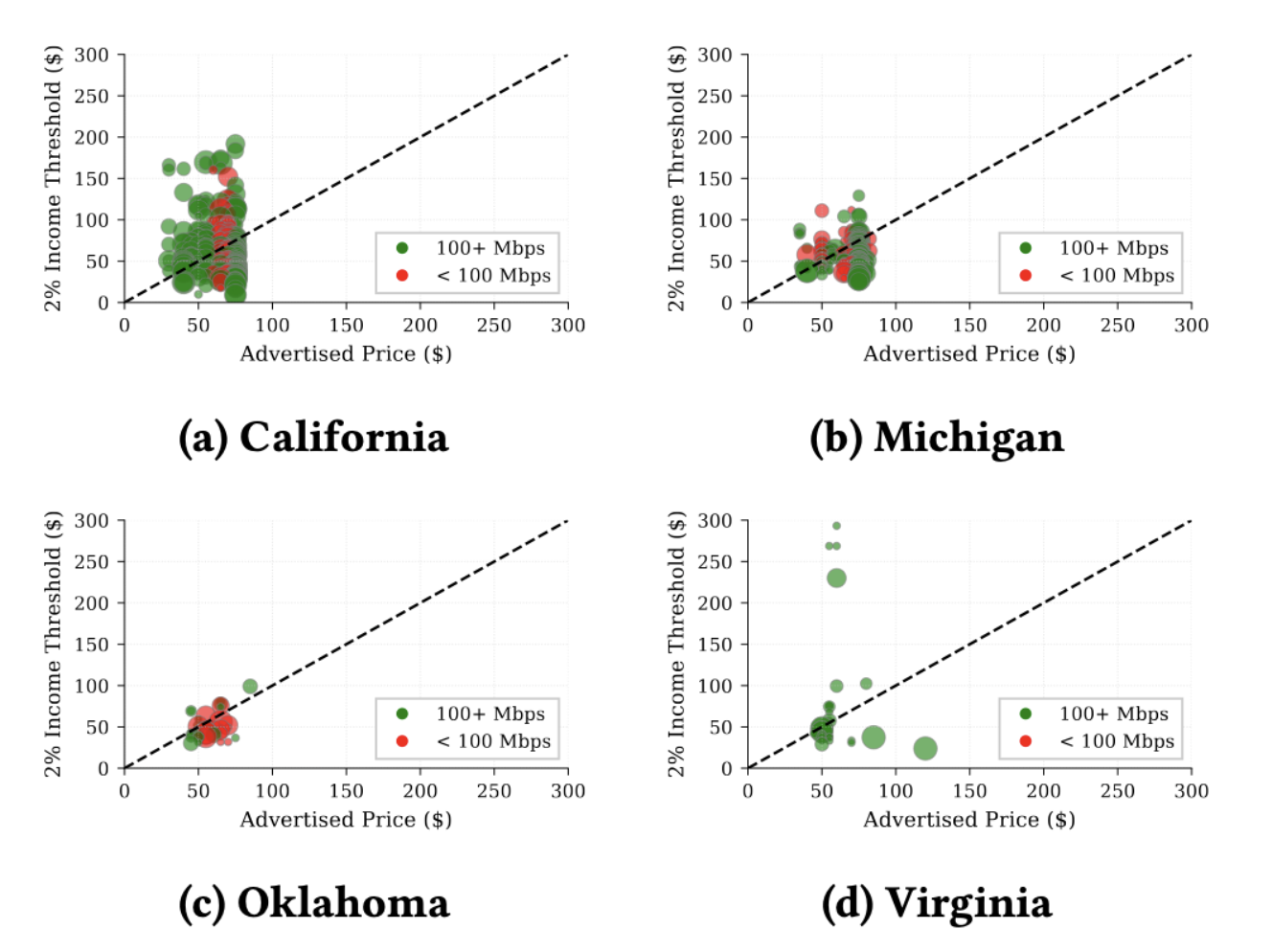
Figures (a)-(d) summarize baseline service conditions across BEAD-eligible CBGs in all four states. Each dot represents a CBG, with green indicating representative plans greater than or equal to 100 Mbps and red indicating representative plans less than 100 Mbps. Dot size reflects data coverage quality. Diagonal dashed lines indicate income affordability boundaries (dots below the diagonal exceed the 2% income threshold). The findings show the prevalence of affordability barriers across states, which may require policy interventions beyond traditional regulatory approaches.
Policy implications
These baseline findings underscore the need for independent, longitudinal oversight throughout BEAD implementation.
1. Monitor more than deployment counts
Tracking miles of fiber or numbers of newly served locations is not enough. Oversight must also track:
- actual consumer-facing prices
- whether plans meet speed benchmarks
- whether improvements reach the places most targeted by BEAD
2. Detect problems early
Because ISP websites, plan structures, and market offerings change over time, one-time audits are insufficient. Ongoing monitoring creates the possibility of early intervention when outcomes begin to diverge from program goals.
3. Support actionable oversight
Scalable address-level data collection can equip policy advocates, state broadband offices, legislators, and oversight organizations with timely evidence to evaluate whether BEAD is delivering not just infrastructure, but meaningful and affordable connectivity.
Why this matters
BEAD represents a once-in-a-generation public investment. Its success should not be judged only by where infrastructure is built, but by whether households can actually obtain and afford the service that infrastructure makes possible.
By enabling scalable and sustained collection of broadband plan data across heterogeneous and evolving ISP interfaces, BQT+ can help build the intervention infrastructure needed for BEAD oversight at national scale.
That makes it possible to move from passive observation to timely intervention — ensuring that public broadband investments deliver not only access, but also affordability, adoption, and equity.
A complete discussion of the analysis and policy recommendations is available at this link. This paper was also published at TPRC 2025